Existence-uniqueness: Difference between revisions
(Created page with "Consider an IVP for a general first order scalar ODE. <math> \begin{cases} y' = f(t,y)\\ y(t_0) = y_0 \end{cases} </math> The '''existence-uniqueness theorem''' theorem states that if <math>f(t,y)</math> and its derivative w.r.t. y is continuous in some rectangle <math>a<t<b</math>, <math>c<y<d</math> about <math>(t_0, y_0)</math>, then there exists a unique solution of the IVP defined for some time interval <math>a'<t<b'</math> about...") |
No edit summary |
||
| (2 intermediate revisions by the same user not shown) | |||
| Line 1: | Line 1: | ||
[[Category:Differential Equations]] | |||
The '''existence-uniqueness theorem''' generally describes that a unique solution to IVP exists. It has varying (but very similar) criterias for different ODEs. | |||
== Linear second order == | |||
Suppose that p, q, and g are continuous functions over an interval <math>a<t<b</math>, and <math>y_0, y_0'</math> are real numbers. There exists a unique twice continuously differentiable function such that | |||
<math> | |||
\begin{cases} | |||
y'' + p(t)y'+q(t)y=g(t)\\ | |||
y'(t_0) = y_0'\\ | |||
y(t_0) = y_0 | |||
\end{cases} | |||
</math> | |||
== Non-linear first order == | |||
Consider an IVP for a general first order scalar [[Ordinary differential equation|ODE]]. | Consider an IVP for a general first order scalar [[Ordinary differential equation|ODE]]. | ||
| Line 8: | Line 25: | ||
</math> | </math> | ||
The | The theorem states that if <math>f(t,y)</math> and <math>\frac{\partial f}{\partial y}</math> is continuous in some rectangle <math>a<t<b</math>, <math>c<y<d</math> about <math>(t_0, y_0)</math>, then there exists a unique solution of the IVP defined for some time interval <math>a'<t<b'</math> about <math>t_0</math>. | ||
= Notes = | = Notes = | ||
The time interval may be much shorter than <math>a<t<b</math>. The solution gives ''no information'' on the time interval. This means that the solution can go off to undefined values even when the inputs are defined. | The time interval may be much shorter than <math>a<t<b</math>. The solution gives ''no information'' on the time interval. This means that the solution can go off to undefined values even when the inputs are defined. | ||
Differentiability is important to ensure that the solution is unique. | |||
= Geometric intuition = | = Geometric intuition = | ||
Geometrically, <math>f(t,y)</math> is the slope. Consider the vector <math>(1,f(t,y))</math>. This vector would be tangential to the movement of the curve. | Geometrically, <math>f(t,y)</math> is the slope. Consider the vector <math>(1,f(t,y))</math>. This vector would be tangential to the movement of the curve. | ||
Latest revision as of 00:23, 18 May 2024
The existence-uniqueness theorem generally describes that a unique solution to IVP exists. It has varying (but very similar) criterias for different ODEs.
Linear second order
Suppose that p, q, and g are continuous functions over an interval , and are real numbers. There exists a unique twice continuously differentiable function such that


Non-linear first order
Consider an IVP for a general first order scalar ODE.
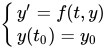
The theorem states that if and is continuous in some rectangle , about , then there exists a unique solution of the IVP defined for some time interval about .


Notes
The time interval may be much shorter than . The solution gives no information on the time interval. This means that the solution can go off to undefined values even when the inputs are defined.
Differentiability is important to ensure that the solution is unique.
Geometric intuition
Geometrically, is the slope. Consider the vector . This vector would be tangential to the movement of the curve.