Second Order Circuits: Difference between revisions
No edit summary |
|||
| Line 186: | Line 186: | ||
<math> | <math> | ||
i(t) = A_1 e^{s_1 t} + A_2 e^{s_2 t} | i(t) = A_1 e^{s_1 t} + A_2 e^{s_2 t} | ||
</math> | </math> | ||
Revision as of 10:22, 8 March 2024
Second order circuits are circuits that have two energy storage elements, resulting in second-order differential equations.
One application of second order circuits is in timing computers. As we will see, an RLC circuit can generate a sinusoidal wave.
There are primarily two types of second order circuits:
- Parallel RLC circuits
- Series RLC circuits
This page will analyze them and derive some useful equations.
Parallel RLC Circuits
Natural Response

By KCL,
Failed to parse (SVG (MathML can be enabled via browser plugin): Invalid response ("Math extension cannot connect to Restbase.") from server "https://wikimedia.org/api/rest_v1/":): {\displaystyle \frac{v}{R} + \frac{1}{L} \int_0^t v d\tau + I_0 + C \frac{dv}{dt} = 0 }
By differentiating once with respect to Failed to parse (SVG (MathML can be enabled via browser plugin): Invalid response ("Math extension cannot connect to Restbase.") from server "https://wikimedia.org/api/rest_v1/":): {\displaystyle t} and rearranging some constants,
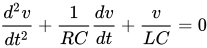
Failed to parse (SVG (MathML can be enabled via browser plugin): Invalid response ("Math extension cannot connect to Restbase.") from server "https://wikimedia.org/api/rest_v1/":): {\displaystyle \frac{d^2 v}{dt^2} + \frac{1}{RC} \frac{dv}{dt} + \frac{v}{LC} = 0 }
we get a homogeneous second-order differential equation, which has a standard solution that I will not go into detail. Briefly, it is solved by assuming Failed to parse (SVG (MathML can be enabled via browser plugin): Invalid response ("Math extension cannot connect to Restbase.") from server "https://wikimedia.org/api/rest_v1/":): {\displaystyle v = A e^{st}} since derivatives of Failed to parse (SVG (MathML can be enabled via browser plugin): Invalid response ("Math extension cannot connect to Restbase.") from server "https://wikimedia.org/api/rest_v1/":): {\displaystyle v} must take the same form to cancel out to zero.
By applying the standard solution, we have
Failed to parse (SVG (MathML can be enabled via browser plugin): Invalid response ("Math extension cannot connect to Restbase.") from server "https://wikimedia.org/api/rest_v1/":): {\displaystyle A e^{st} \left(s^2 + \frac{s}{RC} + \frac{1}{LC} \right) = 0 }
Characteristic Equation
The above simplifies to
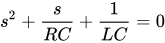
Failed to parse (SVG (MathML can be enabled via browser plugin): Invalid response ("Math extension cannot connect to Restbase.") from server "https://wikimedia.org/api/rest_v1/":): {\displaystyle s^2 + \frac{s}{RC} + \frac{1}{LC} = 0 }
This is the characteristic equation of the differential equation, as the root of the quadratic determines properties of Failed to parse (SVG (MathML can be enabled via browser plugin): Invalid response ("Math extension cannot connect to Restbase.") from server "https://wikimedia.org/api/rest_v1/":): {\displaystyle v(t)}
Failed to parse (SVG (MathML can be enabled via browser plugin): Invalid response ("Math extension cannot connect to Restbase.") from server "https://wikimedia.org/api/rest_v1/":): {\displaystyle s_{1,2} = - \frac{1}{2RC} \pm \sqrt{ \left(\frac{1}{2RC}\right)^2 - \frac{1}{LC}} = - \alpha \pm \sqrt{\alpha^2 - \omega_0^2} }
where
Failed to parse (SVG (MathML can be enabled via browser plugin): Invalid response ("Math extension cannot connect to Restbase.") from server "https://wikimedia.org/api/rest_v1/":): {\displaystyle \alpha = \frac{1}{2RC} }
and
Failed to parse (SVG (MathML can be enabled via browser plugin): Invalid response ("Math extension cannot connect to Restbase.") from server "https://wikimedia.org/api/rest_v1/":): {\displaystyle \omega_0 = \frac{1}{\sqrt{LC}} }
It can be pretty easily proven that the sum of the two roots is also a solution
Failed to parse (SVG (MathML can be enabled via browser plugin): Invalid response ("Math extension cannot connect to Restbase.") from server "https://wikimedia.org/api/rest_v1/":): {\displaystyle v = A_1 e^{s_1 t} + A_2 e^{s_2 t} }
Forms
Depending on the root, there are three forms:
- Overdamped, where there are real, distinct solutions
- Underdamped, where there are complex solutions
- Critically damped, where the solutions are not distinct.
Overdamped
For an overdamped response, we have
Failed to parse (SVG (MathML can be enabled via browser plugin): Invalid response ("Math extension cannot connect to Restbase.") from server "https://wikimedia.org/api/rest_v1/":): {\displaystyle v = A_1 e^{s_1 t} + A_2 e^{s_2 t} }
The A's can be solved by substituting in Failed to parse (SVG (MathML can be enabled via browser plugin): Invalid response ("Math extension cannot connect to Restbase.") from server "https://wikimedia.org/api/rest_v1/":): {\displaystyle v(0)} and Failed to parse (SVG (MathML can be enabled via browser plugin): Invalid response ("Math extension cannot connect to Restbase.") from server "https://wikimedia.org/api/rest_v1/":): {\displaystyle dv(0) / dt = i_C / C}
Failed to parse (SVG (MathML can be enabled via browser plugin): Invalid response ("Math extension cannot connect to Restbase.") from server "https://wikimedia.org/api/rest_v1/":): {\displaystyle v(0) = A_1 + A_2 }
Failed to parse (SVG (MathML can be enabled via browser plugin): Invalid response ("Math extension cannot connect to Restbase.") from server "https://wikimedia.org/api/rest_v1/":): {\displaystyle dv(0)/dt = A_1 s_1 + A_2 s_2 = \frac{1}{C} \left( \frac{-V_0}{R} - I_0 \right) }
Underdamped
For an underdamped response, we have
Failed to parse (SVG (MathML can be enabled via browser plugin): Invalid response ("Math extension cannot connect to Restbase.") from server "https://wikimedia.org/api/rest_v1/":): {\displaystyle s_{1,2} = - \alpha \pm j \omega_d }
where there is damped radian frequency
Failed to parse (SVG (MathML can be enabled via browser plugin): Invalid response ("Math extension cannot connect to Restbase.") from server "https://wikimedia.org/api/rest_v1/":): {\displaystyle \omega_d = \sqrt{w_0^2 - \alpha^2} }
From Euler's identity, the natural response comes to
Failed to parse (SVG (MathML can be enabled via browser plugin): Invalid response ("Math extension cannot connect to Restbase.") from server "https://wikimedia.org/api/rest_v1/":): {\displaystyle v(t) = B_1 e^{-\alpha t} \cos \omega_d t + B_2 e^{-\alpha t} \sin \omega_d t }
The rest is identical to that of overdamped:
Failed to parse (SVG (MathML can be enabled via browser plugin): Invalid response ("Math extension cannot connect to Restbase.") from server "https://wikimedia.org/api/rest_v1/":): {\displaystyle B_1 = V_0 }
Failed to parse (SVG (MathML can be enabled via browser plugin): Invalid response ("Math extension cannot connect to Restbase.") from server "https://wikimedia.org/api/rest_v1/":): {\displaystyle -\alpha B_1 + \omega_d B_2 = \frac{1}{C} \left( \frac{-V_0}{R} - I_0 \right) }
Characteristics
Voltage alternates between positive and negative values due to the two types of energy-storage elements. It's like a mass suspended on a spring.
The oscillation rate is fixed by Failed to parse (SVG (MathML can be enabled via browser plugin): Invalid response ("Math extension cannot connect to Restbase.") from server "https://wikimedia.org/api/rest_v1/":): {\displaystyle \omega_d} , which is why it is called the damped radian frequency.
The oscillation amplitude decreases exponentially at a rate determined by Failed to parse (SVG (MathML can be enabled via browser plugin): Invalid response ("Math extension cannot connect to Restbase.") from server "https://wikimedia.org/api/rest_v1/":): {\displaystyle \alpha} , so it is called the damping factor.
Notice that when Failed to parse (SVG (MathML can be enabled via browser plugin): Invalid response ("Math extension cannot connect to Restbase.") from server "https://wikimedia.org/api/rest_v1/":): {\displaystyle R \neq 0} , there is Failed to parse (SVG (MathML can be enabled via browser plugin): Invalid response ("Math extension cannot connect to Restbase.") from server "https://wikimedia.org/api/rest_v1/":): {\displaystyle \alpha > 0} and the circuit is damped.
Series RLC Circuits
Calculations are very similar to that of parallel circuits, so I'll speed things up.
Natural Response

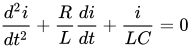
The second order differential from KVL is
Failed to parse (SVG (MathML can be enabled via browser plugin): Invalid response ("Math extension cannot connect to Restbase.") from server "https://wikimedia.org/api/rest_v1/":): {\displaystyle \frac{d^2 i}{dt^2} + \frac{R}{L} \frac{di}{dt} + \frac{i}{LC} = 0 }
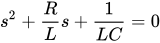
The resulting characteristic equation is
Failed to parse (SVG (MathML can be enabled via browser plugin): Invalid response ("Math extension cannot connect to Restbase.") from server "https://wikimedia.org/api/rest_v1/":): {\displaystyle s^2 + \frac{R}{L}s + \frac{1}{LC} = 0 }
with roots
Failed to parse (SVG (MathML can be enabled via browser plugin): Invalid response ("Math extension cannot connect to Restbase.") from server "https://wikimedia.org/api/rest_v1/":): {\displaystyle s_{1,2} = - \frac{R}{2L} \pm \sqrt{\left( \frac{R}{2L} \right)^2 - \frac{1}{LC}} = - \alpha \pm \sqrt{\alpha^2 - \omega_0^2} }
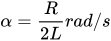
with neper frequency Failed to parse (SVG (MathML can be enabled via browser plugin): Invalid response ("Math extension cannot connect to Restbase.") from server "https://wikimedia.org/api/rest_v1/":): {\displaystyle \alpha = \frac{R}{2L} rad/s} and resonant radian frequency Failed to parse (SVG (MathML can be enabled via browser plugin): Invalid response ("Math extension cannot connect to Restbase.") from server "https://wikimedia.org/api/rest_v1/":): {\displaystyle \omega_0 = \frac{1}{\sqrt{LC}} rad / s}
The form equations are identical to parallel, only with different Failed to parse (SVG (MathML can be enabled via browser plugin): Invalid response ("Math extension cannot connect to Restbase.") from server "https://wikimedia.org/api/rest_v1/":): {\displaystyle \alpha} :
Overdamped:
Failed to parse (SVG (MathML can be enabled via browser plugin): Invalid response ("Math extension cannot connect to Restbase.") from server "https://wikimedia.org/api/rest_v1/":): {\displaystyle i(t) = A_1 e^{s_1 t} + A_2 e^{s_2 t} }
Failed to parse (SVG (MathML can be enabled via browser plugin): Invalid response ("Math extension cannot connect to Restbase.") from server "https://wikimedia.org/api/rest_v1/":): {\displaystyle A_1 + A_2 = I_0 }
Failed to parse (SVG (MathML can be enabled via browser plugin): Invalid response ("Math extension cannot connect to Restbase.") from server "https://wikimedia.org/api/rest_v1/":): {\displaystyle A_1 s_1 + A_2 s_2 = \frac{1}{L}(-RI_0 - V_0) }
Underdamped:
Failed to parse (SVG (MathML can be enabled via browser plugin): Invalid response ("Math extension cannot connect to Restbase.") from server "https://wikimedia.org/api/rest_v1/":): {\displaystyle v(t) = B_1 e^{-\alpha t} \cos \omega_d t + B_2 e^{-\alpha t} \sin \omega_d t }
Failed to parse (SVG (MathML can be enabled via browser plugin): Invalid response ("Math extension cannot connect to Restbase.") from server "https://wikimedia.org/api/rest_v1/":): {\displaystyle B_1 = I_0 }
Failed to parse (SVG (MathML can be enabled via browser plugin): Invalid response ("Math extension cannot connect to Restbase.") from server "https://wikimedia.org/api/rest_v1/":): {\displaystyle -\alpha B_1 + \omega_d B_2 = \frac{1}{L} (-RI_0 - V_0) }
Critically damped:
Failed to parse (SVG (MathML can be enabled via browser plugin): Invalid response ("Math extension cannot connect to Restbase.") from server "https://wikimedia.org/api/rest_v1/":): {\displaystyle i(t) = D_1 t e^{- \alpha t} + D_2 t e^{- \alpha t} }
Failed to parse (SVG (MathML can be enabled via browser plugin): Invalid response ("Math extension cannot connect to Restbase.") from server "https://wikimedia.org/api/rest_v1/":): {\displaystyle D_2 = I_0 }
Failed to parse (SVG (MathML can be enabled via browser plugin): Invalid response ("Math extension cannot connect to Restbase.") from server "https://wikimedia.org/api/rest_v1/":): {\displaystyle D_1 - \alpha D_2 = \frac{1}{L} (-RI_0 - V_0) }