Ordinary differential equation: Difference between revisions
| Line 30: | Line 30: | ||
= Classification = | = Classification = | ||
== Linearity == | |||
An ODE is '''linear''' if all terms are proportional to <math>y, y', | An ODE is '''linear''' if all terms are proportional to <math>y, y', | ||
y''. \ldots</math> or are given functions of <math>t</math>. This | y''. \ldots</math> or are given functions of <math>t</math>. | ||
This | |||
distinction is especially useful since linear combination can be used to | distinction is especially useful since linear combination can be used to | ||
construct solutions. | construct solutions. As one see from [[Linear Algebra]], for a linear problem, a general solution can be constructed from ''one specific solution'' and the ''homogeneous solution''. | ||
== Other Classifications == | |||
The '''order''' of an ODE is the order of its highest derivative. | The '''order''' of an ODE is the order of its highest derivative. | ||
| Line 41: | Line 45: | ||
simultaneously. | simultaneously. | ||
Here is a list of ODEs we study, from simple to complex: | == Solvable Classes == | ||
Here is a list of ODEs we study and solve, from simple to complex: | |||
* [[Linear First Order ODE]] | * [[Linear First Order ODE]] | ||
* | |||
= Applications = | = Applications = | ||
Revision as of 21:31, 15 April 2024
An ordinary differential equation (ODE) relates a function and its
derivatives. We usually use to denote the function and
to denote the variable.


Ordinary means that the equation has one variable, as opposed to partial differential.
There is no general method to solve ODEs. We separate them by classes and solve them individually.
Example
An example of an ODE is the following

The general solution of the above is

Notably, the solution is homogeneous, meaning that is a solution. This will probably be covered later.

Classification
Linearity
An ODE is linear if all terms are proportional to or are given functions of .

This distinction is especially useful since linear combination can be used to construct solutions. As one see from Linear Algebra, for a linear problem, a general solution can be constructed from one specific solution and the homogeneous solution.
Other Classifications
The order of an ODE is the order of its highest derivative.
In a scalar, there is only one unknown function . In a system, there are several, and you have to solve them simultaneously.

Solvable Classes
Here is a list of ODEs we study and solve, from simple to complex:
Applications
Since the derivative can be described as the rate of change, and the function itself is the state, ODEs arises as mathematical models of systems whose rate of change depends on the state of the system.
The following are brief descriptions of some applications of ODEs.
- Radioactive decay, where the function is the (large) number of atoms.
- Atoms decay at an average constant rate
- Object falling under gravity, where the function is the velocity of the object


Here are some more general questions that are solved by ODEs
- Initial Value Problem: Use an initial value of a function and an ODE to generate a function.
- Equilibrium Solution: Find the equilibrium solution of an initial value problem
Dimensional Analysis
The two sides of the equation must match in dimensions (aka. units). This also applies in ODEs.
Consider radioactive decay.

The solution comes to
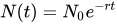
We use time constant to get a sense of how fast it is decaying. Its units is time.